 By Alex
 Pangram AI detection goes beyond real-or-fake verdicts
Pangram CEO Max Spero argues that AI detection must distinguish human work, AI assistance and fully generated content as synthetic media spreads across the internet.
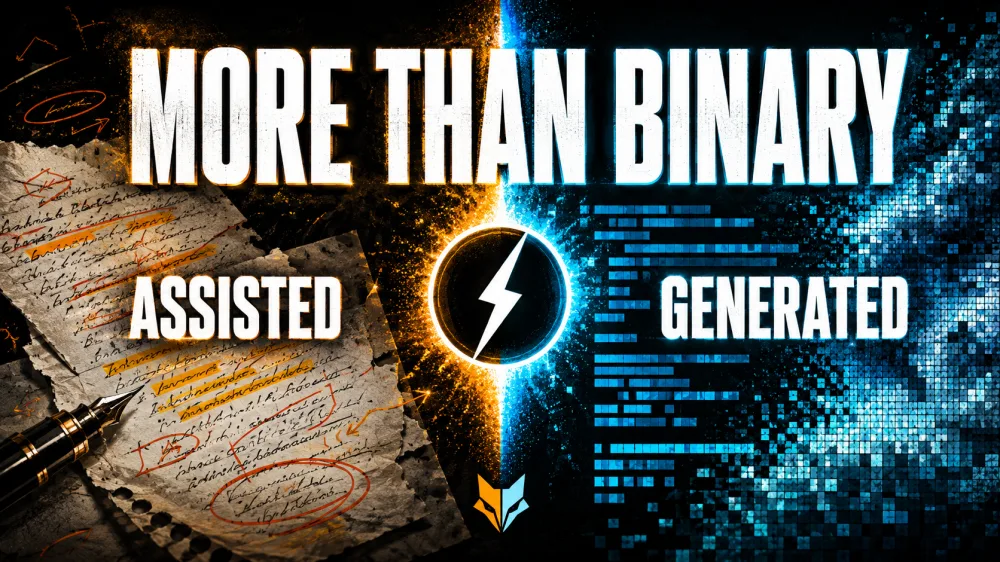
Pangram is making the case that AI detection needs more than a binary label. In a TechCrunch video discussion with Pangram CEO and co-founder Max Spero, the focus is the growing difficulty of telling what is human, what is AI-assisted and what is fully generated as synthetic text and images enter job applications, product reviews and insurance claims. For businesses, the practical response is to use detection to identify what kind of AI involvement requires review rather than to issue an instant verdict.
Definition: AI detection estimates whether content shows patterns associated with AI generation or assistance; it does not independently prove authorship.
Example: A document can contain human-written material edited by an AI system rather than fit neatly into a human-or-machine category.
Key takeaway: A useful detector must expose degrees and locations of AI involvement instead of forcing every result into “real” or “fake.”
Business impact: Companies need policies and review workflows that interpret detection signals before they affect hiring, publishing, moderation or claims.
What is Pangram's real-or-fake problem?
The problem Pangram is addressing is not simply whether an AI model touched a document. The TechCrunch discussion describes a trust layer for an internet where AI-generated text and images are reaching consequential contexts, including job applications, product reviews and insurance claims. Because those examples involve decisions about people and money, businesses should use detection to identify what kind of AI involvement requires review rather than to issue an instant verdict.
Pangram's AI detection problem is that a binary label is too blunt when human writing can be edited with an AI assistant, translated by an AI system or combined with generated passages, while a fully generated document can be revised before submission. Those concrete forms of mixed authorship are why a business should define the decision first—disclosure, fraud screening, editorial review or process compliance—then choose the level of detection evidence that decision requires.
Why does AI assistance matter?
AI assistance matters because human authorship and machine generation can coexist in one piece of work. Pangram's public explanation of detection describes a spectrum that includes fully human, lightly AI-assisted, moderately AI-assisted and fully AI-generated writing, which is a more useful model for review than a single yes-or-no verdict. Teams should therefore ask a detector to locate and characterize suspicious segments before deciding what action is justified.
Pangram's assistance distinction is especially important when a policy is about process rather than style: a publisher may require disclosure of generated passages but allow grammar assistance, a recruiter may care about an applicant's own reasoning, and an insurer may need claim provenance. Those three use cases show why the policy owner—not the Pangram score—must decide the consequence after reviewing the evidence.
How does Pangram make the result more granular?
Pangram's product pages describe segment analysis that breaks a document into smaller units and shows how much of the text displays patterns associated with AI generation. Pangram also describes an AI-assistance view that highlights sections edited by AI rather than treating the entire document as fully generated. For an operator, those two product features turn a score into an investigation map: inspect the marked passages, compare them with the source material and preserve the evidence used for the final decision.
Pangram's public site says its detector analyzes patterns in human and AI writing from models including ChatGPT, Gemini, Grok, Llama and Claude. That named model coverage explains the scope of Pangram's product positioning, not a guarantee that every future model or transformed passage will be classified correctly. Businesses should test Pangram on the languages, document types and editing workflows they actually handle before using its output in a high-impact process.
Why are images part of the same trust problem?
Pangram's AI image detection belongs in the same trust discussion because synthetic media is moving beyond text. The TechCrunch source says Pangram recently released an AI image detection tool, while the company's public product pages describe image detection alongside its text detector. That text-and-image scope gives platforms and organizations another screening input, but the concrete requirement remains provenance, context and human review.
Pangram's text and image detectors create different evidence problems: a text detector can point to linguistic segments, while an image detector may need to account for resizing, compression, editing and mixed human-generated content. Those differences mean a responsible workflow is not “run a scan and publish the verdict”; operators should keep the original asset, record what Pangram examined and separate a confidence signal from a claim about the creator's identity or intent.
What should operators do with AI detection?
Operators should treat Pangram's AI detection as a triage layer with an explicit escalation path. The TechCrunch discussion names applications where a false accusation or false reassurance can carry real cost—hiring, reviews, insurance and public information—so businesses should document Pangram's scope, retain the underlying material and require corroborating evidence before taking adverse action.
A practical Pangram review policy can use three steps—flag the content, inspect the highlighted evidence and ask the creator or submitter to explain the process. Those three steps keep the threshold tied to the decision's stakes and to whether the organization permits brainstorming, translation, editing or drafting assistance. This approach preserves the value of Pangram without turning a probabilistic output into an unreviewable credibility rating. For the wider governance problem, see why AI writing detectors can weaken trust.
What remains uncertain about AI detection?
The central Pangram uncertainty is not whether detection tools can find useful patterns; it is how much weight a particular result deserves in a particular workflow. Pangram's public materials describe model coverage, segment analysis and an image-detection research preview, while the TechCrunch discussion presents the broader challenge of deciding where to draw the line between assistance and generation. Those product and policy facts explain why a Pangram result should inform a decision, not serve as proof that every classification is definitive.
Pangram's next useful signals for businesses are transparent evaluation methods, clear confidence information and evidence that reflects their own users and content. Pangram's product pages already expose segment analysis and AI-assistance views, concrete examples of why a workflow should inspect evidence rather than only a binary label. The same discipline used to evaluate AI agents in real business workflows applies to Pangram: define the task, test failure modes, set human escalation and measure the outcome.
Frequently asked questions
What is Pangram's AI detection discussion about?
The TechCrunch discussion with Pangram CEO and co-founder Max Spero is about why AI detection cannot be reduced to a simple real-or-fake label. The source frames the problem around AI-generated text and images appearing in job applications, product reviews, insurance claims and other online contexts. It also points to a more useful distinction between AI assistance and fully generated work. For operators, the practical lesson is to treat detection as an authorship and transparency signal that needs interpretation, not as an automatic judgment about a person or document.
Why is AI-assisted content different from fully AI-generated content?
AI-assisted content can begin with human work and use an AI system for tasks such as editing, translation or rewriting, while fully AI-generated content may be produced from a prompt with little human-authored material. Those cases carry different questions about disclosure, responsibility and review. A detector that reports only one binary label hides that difference. A useful workflow should identify what part of a document appears assisted or generated, then apply a policy that matches the context, whether that is publishing, hiring, education or content moderation.
Does Pangram only detect AI-written text?
No. Pangram's public product pages describe text detection alongside an AI image-detection research preview. The company also describes segment analysis for showing how much of a document displays AI-like patterns and an AI assistance view for highlighting edited sections. The TechCrunch source says Pangram recently added an AI image detection tool. That broader scope reflects the same trust problem across different media, but it does not mean a detector can independently prove who created a piece of content or why it was made.
How should businesses use AI detector results?
Businesses should use an AI detector as a review input, not as a standalone verdict. Define the policy first, record the detector's confidence and scope, and ask for corroborating evidence such as drafts, revision history, sources, workflow logs or a conversation with the creator. The right response also depends on the use case: disclosure rules for a marketing asset are different from a hiring decision or an insurance claim. A documented escalation path reduces the risk that a probabilistic signal becomes an invisible credibility score.
Alex
Founder & Lead AI Writer
Alex is the founder of Yowox and lead AI writer since 2024, breaking down complex information into clear, actionable insights for thousands of readers every day. Alex has built AI automation systems for businesses since 2024, focusing on AI agents, workflow automation, and business process optimization.
Save hours. Save thousands.
Practical guides, real workflows, and the latest AI and automation news that matters — straight to your inbox.