 By Alex
 John Deere AI chatbot puts farm data to work
John Deere is testing JD, an AI assistant that answers farmers' questions using field, machine and operational data inside Operations Center.
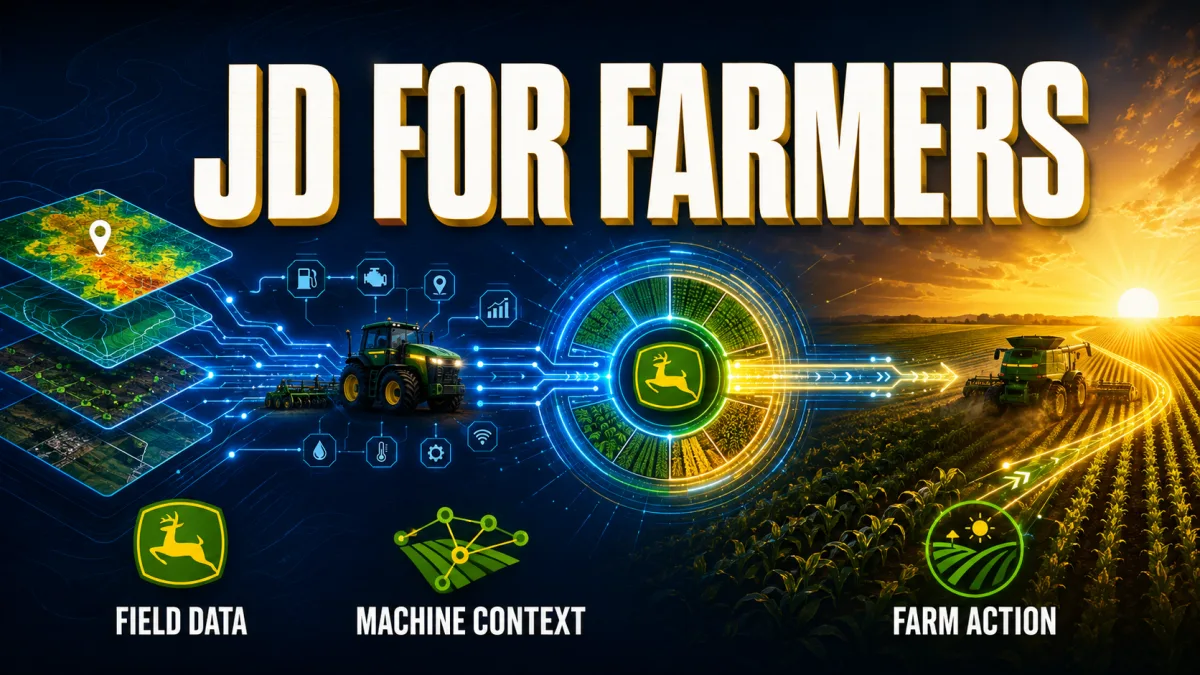
John Deere is testing JD, an AI assistant that turns a farmer's own operational data into answers about equipment and field work. The early-access release is limited to selected US customers inside Operations Center, so the practical story is not a universal farm chatbot yet; it is a data-connected assistant moving through a controlled rollout. The Verge's report identifies the launch, its data inputs and the questions it is designed to address.
Definition: John Deere's JD is an AI assistant for Operations Center that answers questions using a farmer's field, machine and operational data.
Example: A farmer could ask about equipment settings, fuel usage or harvest timing instead of searching through separate dashboards and reports.
Key takeaway: JD is starting as a data-grounded assistant for selected US customers, not as a broadly available autonomous farm operator.
Business impact: The value John Deere is testing is faster access to operational context, while the data controls and rollout limits remain part of the product's trust boundary.
What John Deere's JD assistant can answer
John Deere's JD assistant is designed to answer natural-language questions about a farmer's operation, with the response grounded in equipment, field and operational information. John Deere's own description says JD can provide guidance based on those three data sources, while The Verge names equipment settings, fuel usage and harvest timing as example topics. For a farmer, that means the first use case is finding relevant operational context faster, not handing control of machinery to a chatbot.
John Deere positions JD around three jobs: getting answers, discovering insights and taking action on information. The company says Operations Center brings data from across an operation together, while JD helps farmers use it faster. That makes JD closer to a conversational layer over an existing farm-data system than a standalone general-purpose chatbot; the broader distinction between answering and completing actions is explained in this AI agent guide.
Where John Deere is testing JD
John Deere is testing JD with “select” US customers through an Early Access Program in Operations Center. The current availability is therefore narrow and identifiable: access is tied to the Operations Center environment and the program's selected-customer group, not an open launch for every farmer. Farmers evaluating the announcement should treat the feature as a testable preview rather than assume it is already present in every John Deere account.
John Deere says it plans to expand JD to the web and mobile, then eventually to in-cab displays on tractors and other farm equipment. The company also says it intends to develop capabilities for customers in turf, construction, roadbuilding and forestry. Those are stated expansion plans, not current availability; the immediate product remains the Operations Center test described above.
Why farm-data control is part of the launch
John Deere's AI assistant depends on farm data, so the company's data commitments are as important to the launch as the chat interface. John Deere says farmers control their farm data, that it does not sell that data, and that farmers can choose which third parties receive it or turn that sharing off. The same Farmer Data Commitment also says John Deere does not use farm data for agriculture commodity trading or speculation.
Those promises define the conditions around JD rather than proving how the assistant performs. A farmer considering the tool should separate three questions: what data JD can access, what answers it produces on real farm records, and which sharing controls apply to the account. John Deere has published the control principles, but the Early Access Program will be the setting where customers can judge whether the answers are useful enough to justify the data connection.
What John Deere has not disclosed about the AI
John Deere has not identified the AI technology behind JD in the material reported for this launch. That missing detail matters because the model, retrieval method, evaluation process and failure handling would affect how a business assesses reliability. The public information supports a narrower conclusion: JD is an AI assistant that uses John Deere's operational data, but its underlying model and technical architecture are not specified.
That uncertainty is a reason to evaluate the product by observable workflow outcomes rather than by the label “AI.” A useful review would check whether JD cites the right field or machine context, handles incomplete records, distinguishes historical trends from current conditions and makes its limits clear. Those are the same layers businesses should inspect in any data-connected automation stack; the AI automation stack overview maps the model, data and tool layers without assuming a particular vendor's implementation.
What farmers should watch next
The next meaningful test for JD is whether conversational access changes day-to-day decisions without weakening control over farm data. John Deere has supplied a concrete starting point — selected US testing in Operations Center, questions about equipment and operations, and a stated path toward web, mobile and in-cab access — but it has not published a broad performance result or the system's underlying AI technology.
For now, the defensible reading is straightforward: John Deere is adding a data-grounded AI assistant to its farm-management platform, and it is testing whether faster answers can create value for operators. Availability, technical transparency and real-world reliability will determine whether JD becomes a useful layer across farm operations or remains a limited interface on top of existing dashboards.
Frequently asked questions
What is John Deere's JD AI assistant?
JD is an AI assistant inside John Deere Operations Center. John Deere says it can answer natural-language questions and surface insights using information from a farmer's equipment, fields and operation. The company is testing it with selected US customers before broader availability.
What data can JD use to answer farmers' questions?
John Deere says JD can use field, machine and operational data. The Verge reports that the assistant is intended for questions about equipment settings, fuel usage and harvest timing, with answers based on each farmer's own data and historical trends.
Is John Deere's JD assistant available to every farmer?
No. John Deere is testing JD with select US customers through its Early Access Program in Operations Center. The company plans to expand it to the web and mobile, and eventually to in-cab displays on tractors and other equipment, but the broad rollout has not happened yet.
Alex
Founder & Lead AI Writer
Alex is the founder of Yowox and lead AI writer since 2024, breaking down complex information into clear, actionable insights for thousands of readers every day. Alex has built AI automation systems for businesses since 2024, focusing on AI agents, workflow automation, and business process optimization.
Save hours. Save thousands.
Practical guides, real workflows, and the latest AI and automation news that matters — straight to your inbox.