 By Alex
 Dario Amodei’s AI warning: China, not open weights
Anthropic CEO Dario Amodei says open-weight models are not the target of a ban; he wants tougher action on authoritarian AI capability, chip access, distillation, and safety testing.
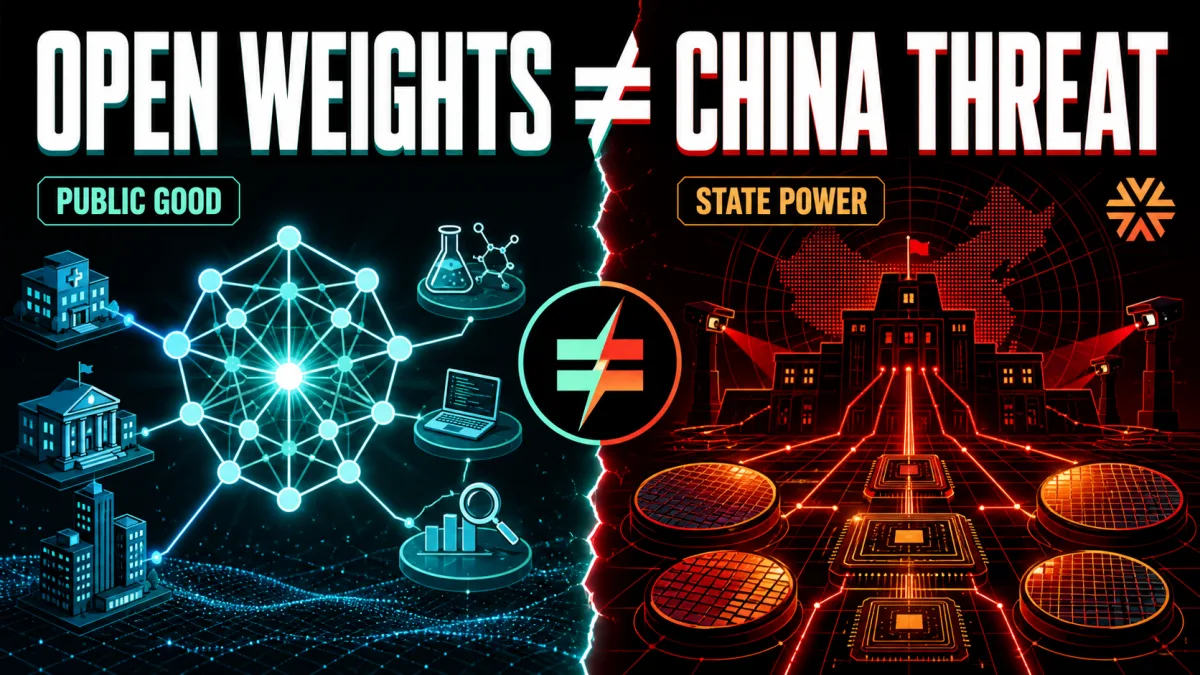
Anthropic CEO Dario Amodei says the company does not want a blanket ban on open-weight models; his sharper concern is that authoritarian governments, especially China, could build more powerful AI for military superiority or repression. In his July 27 response, covered by a TechCrunch report, Amodei separates the openness of a model from the geopolitical threat posed by the state developing or using it. For the policy debate, that distinction matters more than the headline claim that Anthropic is simply “against open weights.”
The clarification follows a US debate over Chinese models, alleged intellectual-property theft, and whether Washington should restrict open-weight AI. Yowox previously covered why Kimi K3 turned open weights into a US policy fight; Amodei’s response adds Anthropic’s own line between competition, misuse, and national-security risk.
Definition: An open-weight model makes its trained parameters available for others to download and run, while a closed model is accessed through a provider-controlled service.
Example: A business can run an open-weight model inside its own infrastructure, but it may also lose some provider-level monitoring and withdrawal controls once the weights are released.
Key takeaway: Amodei says open weights are not the policy target; dangerous capability, state-backed acceleration, distillation, and inadequate safety testing are.
Business impact: Companies evaluating Chinese or other open-weight models should assess the actual model, software supply chain, permissions, and safety evidence instead of using “open” or “Chinese” as a complete risk verdict.
What did Dario Amodei clarify about open-weight models?
Dario Amodei’s central clarification is direct: Anthropic has never advocated banning open-weight models as a category. In Anthropic’s own statement, Amodei calls open-weight models without dangerous capabilities a public good because businesses, developers, and researchers can use them with only the compute required to run them. The practical takeaway is that Anthropic’s position is not “closed models good, open models bad”; it is a request to distinguish useful access from dangerous capability.
Amodei’s position also accepts that open weights can strengthen competition and give customers more control. That concession matters because the surrounding argument is partly commercial: downloadable models can reduce dependence on provider-controlled APIs and pressure closed labs on pricing and adoption. A company reading the policy debate should therefore separate Anthropic’s stated safety concerns from the market effect that open models can have on Anthropic’s business.
Why does Anthropic focus on China and authoritarian AI?
Amodei says his primary fear is that an authoritarian government could build models more powerful than US models and use them for permanent military superiority or deep repression. He identifies the Chinese Communist Party as the most capable authoritarian threat, but says the concern is not limited to China. The policy implication is that the decisive question is who controls frontier capability and what that actor can do with it—not whether the model’s weights are technically open.
That argument changes the target of intervention. A powerful model trained in secret and reserved for military or surveillance use could be dangerous even if no open-weight model exists, while a less capable open model used by a normal business may not be the central national-security risk Amodei describes. For operators, the useful distinction is between the model’s capability, the developer’s incentives, the deployment environment, and the actions the system can reach.
What risks does Amodei still assign to open weights?
Amodei says open-weight models may create higher misuse risk when they are powerful because users can remove safeguards, private operators are harder to monitor, and released weights cannot be withdrawn. He highlights cyber and biological attacks as examples where the ability to access a capable model could matter, while acknowledging that the risk applies to open models from China or elsewhere. The operational takeaway is to test capabilities directly rather than assume that a model is safe because it is open or unsafe because it is foreign. Related reading: China May Restrict Overseas Access to DeepSeek and Other Top AI Models.
Amodei rejects the claim that broad access necessarily helps defenders more than attackers. His concern is especially strong for biological misuse, where he argues that attackers may be able to act faster than defenders can build a response. That is a warning about an unresolved empirical question, not proof that every open-weight model creates the same danger. Teams should treat the claim as a reason to demand evidence from safety evaluations, not as a substitute for evaluating a specific system.
Which policies does Anthropic support instead of a blanket ban?
Anthropic’s proposed response has three parts: restrict China’s access to powerful chips and chipmaking equipment, crack down on industrial-scale distillation operations, and require safety testing for all sufficiently capable models, whether open or closed. Amodei presents those measures as more targeted than a blanket open-weight ban because they address compute access, alleged model extraction, and dangerous capability directly. Policymakers can use the three-part structure to ask whether a proposed rule reaches the risk it claims to solve.
Chip controls are meant to limit the hardware available for training more powerful models. Distillation enforcement is meant to deter operations that use one model’s outputs to improve another at lower compute cost. Capability testing is meant to examine cyber, biological, and alignment risks before release. These are different policy levers, so a company should not treat “open weights” as a single control that can replace hardware restrictions, provenance checks, or model evaluation.
How does this differ from the industry’s open-weight letter?
The industry letter signed by companies including Nvidia, Hugging Face, Meta, Microsoft, and Mistral argues that policymakers should avoid broad, premature restrictions and that open models can improve competition, transparency, and defensive capability. TechCrunch’s report on the letter places it in the same debate over Chinese AI and alleged distillation, but the letter and Amodei’s response emphasize different risk assumptions. The takeaway is not that one side supports safety and the other does not; they disagree over whether openness tends to help defenders more than attackers.
Amodei says the strongest models—open and closed—should face mandatory testing, ideally through a global system that includes China. The open-weight letter instead stresses that defenders need access to comparable models to detect and respond to AI-assisted attacks. That disagreement cannot be settled by branding. It requires tests that compare misuse, defense, monitoring, and rollback under realistic conditions.
What should businesses watch next?
Businesses should treat this debate as a governance question about model capability and control, not as a simple purchasing signal. A team considering an open-weight model should verify what it can do, where it runs, what data and tools it can reach, who can update it, and whether the team can contain or replace it. Those checks are consistent with the broader five-layer view of AI agent security, where model risk is only one layer in a system that also includes interaction, integrations, and code.
The immediate practical distinction is between a model’s weights and the surrounding operating boundary. An open-weight model can improve local control over data and hosting, but it does not automatically provide safe behavior, trustworthy provenance, or easy rollback. A closed API can provide monitoring and access controls, but it does not eliminate capability or provider-dependence risk. Businesses should therefore make the decision with workload-specific testing, least-privilege access, logging, human review for high-impact actions, and a documented exit path.
What remains unsettled in Anthropic’s position?
The unresolved question is whether global safety testing can become credible enough to govern models released across different countries and deployment environments. Amodei says such testing could cover sufficiently capable open and closed models and that limited cooperation on biological risks may be possible even with China. That proposal is more specific than a ban, but its effectiveness depends on shared thresholds, trusted evaluations, enforcement, and participation from the actors it is meant to constrain.
Amodei’s response therefore narrows the argument without ending it. Anthropic is saying that open weights are not the enemy by definition, while still warning that powerful models can create irreversible misuse risks and that China’s frontier capability matters strategically. For readers and policymakers, the durable lesson is to keep competition, country of origin, capability, deployment, and safety evidence separate enough to test each one.
Frequently asked questions
Does Anthropic support banning open-weight AI models?
No. Dario Amodei wrote that Anthropic has never advocated for a ban on open-weight models as a category. He described open-weight models without dangerous capabilities as a public good for businesses, developers, and researchers. Anthropic’s objection is narrower: it wants targeted measures against dangerous capabilities, industrial-scale distillation, and the transfer of advanced chips and chipmaking equipment to China.
Why is Dario Amodei worried about Chinese AI?
Amodei’s primary concern is that an authoritarian government could build models more powerful than those in the United States and use them for permanent military advantage or deep repression. He identifies the Chinese Communist Party as the most capable authoritarian threat, while noting that the concern is not limited to China. In his view, the country of origin matters less than who controls frontier capability and how that capability is used.
What does Anthropic propose instead of a blanket ban?
Anthropic proposes three targeted measures: keep powerful chips and chipmaking equipment out of authoritarian hands, deter industrial-scale distillation operations, and require safety testing for all sufficiently capable models, whether they are open or closed. Amodei argues that safety testing should be global and should examine cyber, biological, and alignment risks directly instead of assuming that openness alone determines the outcome.
What should a business take from this debate?
A business should separate model access from model governance. Open-weight models can offer more control over hosting and data paths, but they can also be harder to monitor, constrain, or withdraw after release. Before adoption, a business should test the exact model for its intended workload, review its license and provenance, restrict network and tool access, and keep a rollback or replacement plan. Those controls are useful whether the model is open-weight or delivered through a closed API.
Alex
Founder & Lead AI Writer
Alex is the founder of Yowox and lead AI writer since 2024, breaking down complex information into clear, actionable insights for thousands of readers every day. Alex has built AI automation systems for businesses since 2024, focusing on AI agents, workflow automation, and business process optimization.
Save hours. Save thousands.
Practical guides, real workflows, and the latest AI and automation news that matters — straight to your inbox.