 By Alex
 AI training on copyrighted books: what courts say now
U.S. courts are treating AI training on copyrighted books as a fact-specific fair-use question: lawful acquisition may help, but piracy, market competition and evidence of harm can change the result.
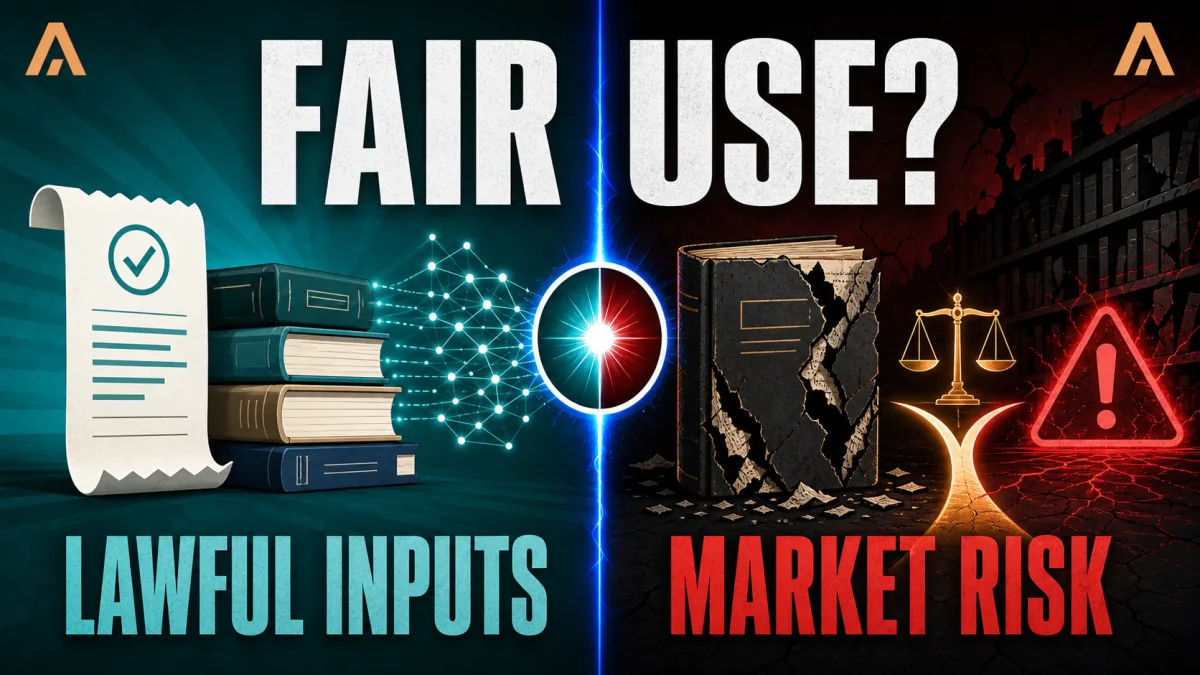
Training an AI model on copyrighted books is not automatically legal or illegal in the United States. Recent cases make the result depend on how the works were acquired, what the model is built to do, whether the use is transformative, and what evidence exists about market harm, according to TechCrunch's review of the dispute.
Definition: AI-training copyright disputes ask whether copying and processing protected works for model development qualifies as fair use under U.S. copyright law.
Example: A court treated Anthropic's training use of lawfully acquired books differently from the company's retention of books obtained from shadow libraries.
Key takeaway: A favorable ruling for one training setup does not create a blanket safe harbor for every dataset or model.
Business impact: AI teams should treat data provenance, model purpose and market-substitution risk as design inputs before training, not as cleanup work after launch.
What does U.S. fair use ask about AI training?
U.S. fair use is a fact-specific defense built around four statutory factors: the purpose and character of the use, the nature of the copyrighted work, the amount used, and the effect on the work's market. The U.S. Copyright Office's AI initiative is still analyzing how those existing rules apply to training, so a company should not treat the phrase "fair use" as a categorical permission slip.
For AI training, the first and fourth factors are doing much of the visible work in current cases. A use looks more defensible when the model serves a meaningfully different purpose from the source and does not act as a substitute for the source. A use looks riskier when the model is built to compete with the source's market or when the record contains credible evidence of lost or threatened demand.
Why did Anthropic's book-training ruling help AI developers?
In Bartz v. Anthropic, Judge William Alsup ruled that using copyrighted books to train Anthropic's language models was lawful under the fair-use analysis described in the case, while separating that conclusion from Anthropic's acquisition of pirated copies. TechCrunch reported that the court later became associated with a $1.5 billion settlement concerning the authors' claims, but the core training ruling was more favorable to AI development than the headline-sized settlement suggests.
The distinction matters because the court treated model training as different from distributing a book to a reader. The court's reasoning, summarized by White & Case's case analysis, treated training as a transformative use while leaving potential liability for copying and retaining massive pirated libraries. For an AI operator, lawful acquisition and training purpose are separate questions that must both be documented.
Why did Ross Intelligence reach the opposite result?
In Thomson Reuters v. Ross Intelligence, Ross used headnote-derived material to train a competing legal-research tool, and the court rejected Ross's fair-use defense. The district court opinion treated the commercial competition and the potential market for AI-training data as important reasons the use was not sufficiently transformative.
Ross is a useful boundary case because the dispute was not simply about whether a model learned from text. The court viewed the training material as helping create a product that competed with the copyright owner's legal-research business. That fact changes the operator's risk analysis: a model that produces a substitute for the source's commercial function is harder to defend than a model whose use has a clearly different purpose.
What does the Meta case add to the picture?
In Kadrey v. Meta, the court also found Meta's use of books to train Llama fair use on the record before it, but the reasoning left a warning for future plaintiffs and defendants. The Ohio State University 2026 update explains that the court considered whether AI could create an indirect market substitute by enabling a large volume of competing works, even though the plaintiffs had not supplied enough evidence to win on that theory.
That split shows why the current cases are not a simple scorecard for either authors or AI companies. One court may find the training purpose transformative, while another part of the same analysis may still turn on market dilution, output similarity or the quality of economic evidence. Companies should preserve evidence about those questions instead of relying on a single favorable sentence from a ruling.
What remains unresolved for AI companies?
The U.S. Copyright Office has released a pre-publication Part 3 of its AI report on generative-AI training, but that document is an analysis of policy and law, not a universal court-issued license. The courts are still applying an older fair-use framework to new systems, and different records can produce different outcomes. That is why the AI training landscape remains favorable in some cases but carries material caveats.
The unresolved questions include how much weight courts should give to a potential licensing market, how to measure indirect substitution by AI-generated works, how output memorization affects the analysis, and how acquisition records should influence the result. Those questions matter to businesses even when they do not train foundation models themselves: a vendor's dataset decisions can become part of a customer's legal and procurement risk.
What should business operators do now?
Business operators evaluating a model or vendor should ask for a clear account of dataset provenance, licensing and filtering rather than accepting a generic statement that the model was trained on publicly available material. "Publicly accessible" does not answer whether a work was copyrighted, lawfully acquired, copied from a shadow library or used in a product that competes with the original market.
The operational checklist is concrete: record the source and permission status of training data, quarantine uncertain material, define the intended output and comparable markets, test for memorization or close reproduction, and route unresolved questions to qualified counsel. The same source-control discipline used for AI agents and their tool permissions applies here: the model is only one part of a system whose data paths and consequences need to be observable.
AI training on copyrighted books is therefore a moving legal-risk question, not a settled yes-or-no feature. Companies can learn from the Anthropic, Meta and Ross decisions, but they should not treat any one of them as a universal rule. As more courts receive better evidence about acquisition, outputs and market effects, the safest strategy is to make the dataset and the intended use defensible before training begins.
For background on how model inputs become part of broader AI systems, see what an AI agent does beyond a chat response.
Frequently asked questions
Is training an AI model on copyrighted books automatically illegal?
No. Recent U.S. cases do not create a blanket rule that training on copyrighted books is always legal or always illegal. Courts have focused on the fair-use factors, including the purpose of the use, the nature of the work, how much was copied, and likely market effects. Anthropic won a ruling on the training use of books that were lawfully acquired, while the same litigation left serious exposure around pirated library copies. The result depends on the dataset, the acquisition method, the model's purpose and the evidence of market harm.
Why did Anthropic's book-training case produce a favorable result?
Judge William Alsup treated Anthropic's use of books to train Claude as highly transformative because the model used the works to generate new text rather than distribute the books as books. The ruling separated that training use from Anthropic's acquisition and retention of pirated copies. The court found the training issue favorable to Anthropic, but the shadow-library conduct remained a separate copyright risk and later led to a reported $1.5 billion settlement with authors. The decision is therefore not a license to use any dataset obtained in any way.
Why did Ross Intelligence lose its fair-use argument?
Ross Intelligence used Thomson Reuters headnote-derived material to build a competing legal-research product. Judge Stephanos Bibas treated that use as commercial and insufficiently transformative, and found that it threatened both the existing legal-research market and a potential market for AI training data. The case is an important counterexample to a simple "training is transformative" rule: when the model supports a direct market substitute, the purpose and market-effect factors can weigh strongly against fair use.
What should a company do before training on copyrighted books?
A company should document where every training work came from, separate legally acquired material from pirated or uncertain copies, define the model's purpose, test whether outputs could substitute for the source works, and obtain specialist legal advice for high-risk datasets. Companies should also preserve records of licenses, permissions, filtering and deletion decisions. These steps do not guarantee a fair-use outcome, but they make the relevant facts reviewable before a dataset becomes part of a costly model or litigation record.
Has the United States settled the AI-training copyright question?
No. The U.S. Copyright Office has published a multi-part Copyright and Artificial Intelligence report, including a pre-publication Part 3 on generative-AI training, while the courts continue to apply existing fair-use doctrine to different records. Anthropic, Meta and Ross produced different analyses of transformation, acquisition and market harm. Appeals, later cases and better economic evidence could change how those principles are applied. Businesses should treat current rulings as guidance for risk review, not as a universal safe harbor.
Alex
Founder & Lead AI Writer
Alex is the founder of Yowox and lead AI writer since 2024, breaking down complex information into clear, actionable insights for thousands of readers every day. Alex has built AI automation systems for businesses since 2024, focusing on AI agents, workflow automation, and business process optimization.
Save hours. Save thousands.
Practical guides, real workflows, and the latest AI and automation news that matters — straight to your inbox.