 By Alex
 Gurobi Modeler Builds Better Optimisation Models
Gurobi's beta Modeler uses guided AI workflows to turn business problems into structured optimisation models before implementation.
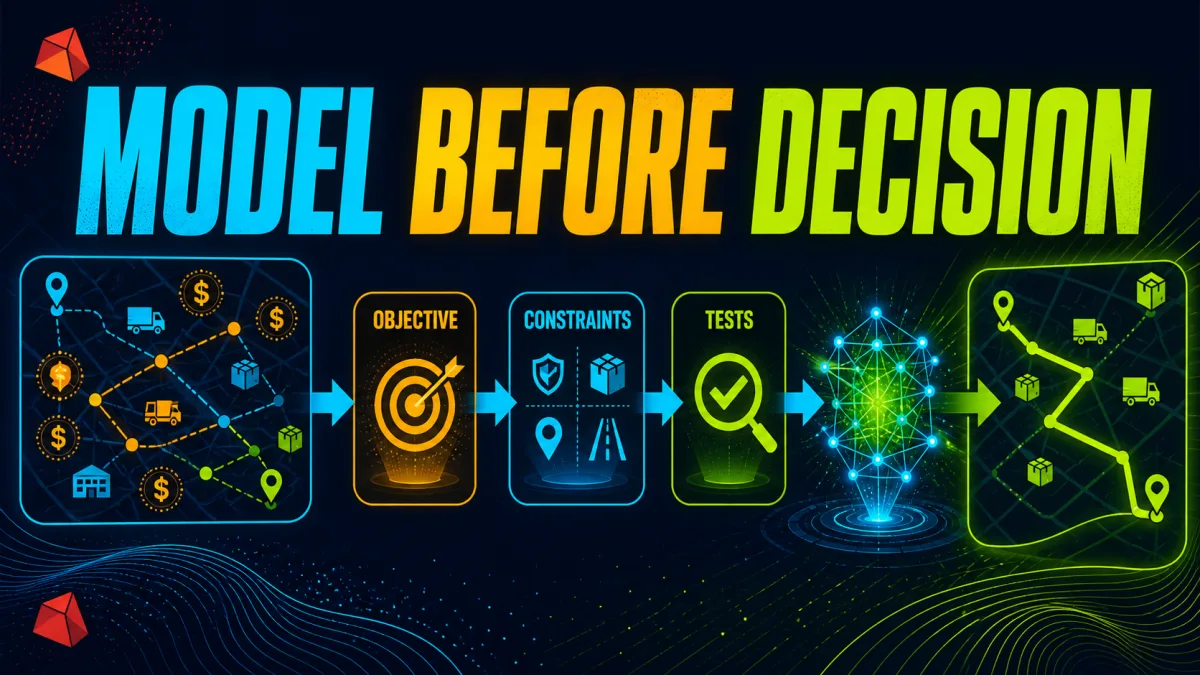
AI optimisation models are becoming easier to formulate, not automatically correct. A new beta feature from Gurobi uses a guided AI workflow to help teams turn a business problem into an optimisation model before they write implementation code. The change matters because the quality of an optimisation decision starts with whether the model represents the real problem.
Definition: AI-guided optimisation uses generative AI to help people define objectives, decision variables, constraints, assumptions and acceptance tests for a mathematical optimisation model.
Example: A distribution team describing a delivery-cost problem can use a guided workflow to clarify whether delivery time is also a priority, which limits are mandatory and what decisions the model should make.
Key takeaway: AI can make model formulation more accessible, but the business still owns the assumptions and validation.
Business impact: Better-defined optimisation models can give teams more confidence in recommendations that affect operations, cost and capacity.
What is the Gurobi Modeler?
Gurobi's announcement describes the Modeler as an AI-powered agent inside the Gurobi Intelligence Hub. The Modeler is currently a beta feature open for use and feedback, and the source positions it as support for the early stages of model development rather than instant code generation. Teams should therefore treat the Modeler as a formulation aid to review, not as an automatic approval of a business decision.
The Gurobi Modeler focuses on formulation because mathematical optimisation can only optimise the objective and constraints a team defines. The source article says the Modeler turns a business conversation into objectives, decision variables, constraints and assumptions, which shows why the definition stage comes before implementation. Teams should challenge that specification before asking a solver to produce a result.
How does the Modeler turn a business problem into a model?
The Modeler uses a question-led workflow to identify the parts of an optimisation model that are easy to leave implicit. According to the source article, it asks users about the primary objective, the importance of delivery times versus transportation cost, mandatory constraints, the decisions the model should make and how the result will be checked. The practical takeaway is to resolve these questions before implementation rather than treating code generation as the first step.
Gurobi's official Intelligence Hub description presents the Modeler workflow as a path from a business problem to a production-quality optimisation model. The workflow includes clarifying requirements, identifying assumptions, developing specifications, creating acceptance tests, validating expected behaviour and iteratively improving the model. Those steps give technical and non-technical participants a shared checklist for deciding whether the formulation is ready to implement.
The Gurobi Modeler is especially relevant when a business objective is clear at a high level but ambiguous in operational terms. The source's delivery-cost example leaves open whether delivery times matter, which constraints are mandatory and what decisions the model should make, so teams should resolve those choices before a solver produces an answer.
Why does model formulation affect decision quality?
Model formulation affects decision quality because an optimisation solver can only optimise the structure it is given. The source's logistics example shows the risk: a team must decide whether delivery time matters alongside transportation cost and which constraints are mandatory. Teams should use the Modeler's formulation questions to expose that mismatch before implementation.
The Gurobi Modeler gives generative AI a different role from simply writing code. The source explicitly contrasts its question-led workflow with jumping directly to code generation, so teams should use the workflow to define what the model may decide, what it must respect and how an acceptable result will be recognised.
What does the Modeler make more accessible?
The Modeler makes the formulation stage more accessible to people who understand the business problem but do not have advanced mathematics or coding skills. Gurobi says the workflow is designed so non-technical stakeholders and optimisation practitioners can work from a shared understanding, with documented assumptions and validation steps reducing common modelling mistakes.
The Gurobi Modeler's shared-understanding goal can expand who participates in optimisation projects. The source article specifically describes non-technical stakeholders and optimisation practitioners working from the same problem definition, so an operations manager, planner and optimisation specialist should use the guided conversation to surface their different requirements before implementation.
The Gurobi Modeler is not presented as a way to turn every business user into an optimisation expert. Its stated benefit is broader participation in defining the problem while optimisation specialists retain the responsibility to review the formulation and implementation, so teams should treat accessibility as collaboration rather than certification.
What should teams still verify before trusting a result?
Teams should verify the Gurobi Modeler's assumptions, data, constraints and acceptance tests before using its recommendations in an operational decision. The source describes the Modeler as a beta feature for clarifying and validating a formulation, so teams should treat that workflow as development support rather than a guarantee that every resulting model fits every business context.
The Gurobi Modeler's review should ask whether the objective matches the decision the organisation wants to improve, whether constraints reflect current policy and physical limits, whether the data is reliable enough and whether acceptance tests detect an implausible result. Gurobi's official workflow lists requirement clarification, assumption identification, acceptance tests and validation, so teams should use those checks before relying on a recommendation and should test missing inputs, conflicting priorities and infeasible cases.
For companies evaluating AI projects more broadly, this is the same discipline as measuring a system by completed outcomes rather than impressive output. A practical AI automation ROI framework can help separate the value of a useful result from the cost of review, rework and maintenance. The related useful-intelligence scorecard makes a similar case for judging AI by dependable work and full cost rather than a narrow model metric.
How does the Gurobi Modeler fit decision intelligence?
The Gurobi Modeler points to a broader direction for enterprise AI: using generative AI around an established analytical system instead of asking a language model to make every decision directly. The source describes the Modeler as combining guided workflows with Gurobi's optimisation expertise, so teams can use AI to define and understand a rigorous model while the optimisation system solves the stated mathematical problem.
The Gurobi Modeler's separation between guided formulation and optimisation is most useful when a decision has many variables, hard constraints and trade-offs that need explanation. The source's objectives, constraints, assumptions and acceptance-criteria workflow makes that separation concrete, so teams should judge the result by whether the model represents a decision they are prepared to act on, not only by how quickly AI produced it.
The Gurobi Modeler is still in beta and open for feedback, so its long-term value will depend on how teams use the workflow, test its formulations and report what needs improvement. The source's beta status makes the practical takeaway clear: evaluate the workflow on real modelling tasks, because better decision quality begins before the solver runs, when a business problem becomes a model.
FAQ
What is Gurobi's Modeler?
Gurobi's Modeler is a beta AI-powered agent in the Gurobi Intelligence Hub. It guides users from a business problem to a structured optimisation model by working through objectives, decision variables, constraints, assumptions and acceptance criteria. Gurobi says the workflow is designed to support users without advanced mathematics or coding skills, while still preserving the structure needed for optimisation work.
How does AI help build optimisation models?
AI helps by making the formulation stage more structured and collaborative. Instead of generating code immediately, Gurobi's Modeler asks questions about the objective, mandatory constraints, decisions the model should make and how the result will be checked. It then captures those requirements as a model specification that can be refined and validated before implementation.
Does an AI-generated optimisation model guarantee a good decision?
No. A guided workflow can improve how a business problem is described and checked, but the decision still depends on the objectives, data, constraints and assumptions chosen by the team. The Modeler is presented as a beta feature that helps users clarify requirements, create acceptance tests and iteratively improve a model; teams still need to validate whether the formulation reflects the real business problem.
Who is the Modeler designed for?
The Modeler is designed for both non-technical stakeholders and optimisation practitioners who need to turn a business challenge into a well-defined model. Gurobi says the guided workflow is intended to lower the barrier created by advanced mathematics and coding requirements, while documenting assumptions and validation steps that help different participants share the same problem definition.
Frequently asked questions
What is Gurobi's Modeler?
Gurobi's Modeler is a beta AI-powered agent in the Gurobi Intelligence Hub. It guides users from a business problem to a structured optimisation model by working through objectives, decision variables, constraints, assumptions and acceptance criteria. Gurobi says the workflow is designed to support users without advanced mathematics or coding skills, while still preserving the structure needed for optimisation work.
How does AI help build optimisation models?
AI helps by making the formulation stage more structured and collaborative. Instead of generating code immediately, Gurobi's Modeler asks questions about the objective, mandatory constraints, decisions the model should make and how the result will be checked. It then captures those requirements as a model specification that can be refined and validated before implementation.
Does an AI-generated optimisation model guarantee a good decision?
No. A guided workflow can improve how a business problem is described and checked, but the decision still depends on the objectives, data, constraints and assumptions chosen by the team. The Modeler is presented as a beta feature that helps users clarify requirements, create acceptance tests and iteratively improve a model; teams still need to validate whether the formulation reflects the real business problem.
Who is the Modeler designed for?
The Modeler is designed for both non-technical stakeholders and optimisation practitioners who need to turn a business challenge into a well-defined model. Gurobi says the guided workflow is intended to lower the barrier created by advanced mathematics and coding requirements, while documenting assumptions and validation steps that help different participants share the same problem definition.
Alex
Founder & Lead AI Writer
Alex is the founder of Yowox and lead AI writer since 2024, breaking down complex information into clear, actionable insights for thousands of readers every day. Alex has built AI automation systems for businesses since 2024, focusing on AI agents, workflow automation, and business process optimization.
Save hours. Save thousands.
Practical guides, real workflows, and the latest AI and automation news that matters — straight to your inbox.