 By Alex
 AI data centers could take 20% of U.S. power by 2035
BloombergNEF's latest forecast points to a fourfold rise in U.S. data-center electricity use by 2035, putting AI growth directly against strained power grids.
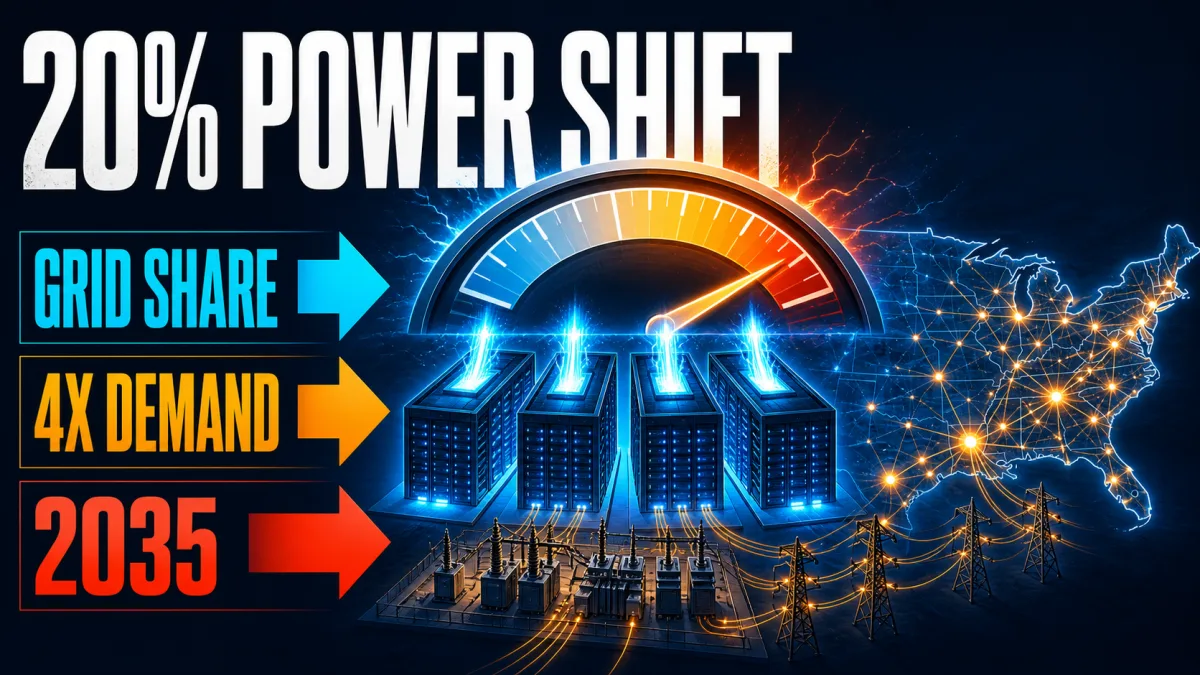
Data centers could consume about one-fifth of U.S. electricity by 2035, or roughly four times their current share, according to a BloombergNEF forecast reported by TechCrunch. The forecast makes AI infrastructure a power-system issue: businesses planning new AI workloads should assess electricity, grid access and regional concentration alongside chips and cloud capacity.
Definition: Data-center electricity demand is the power consumed by facilities that run computing, storage, networking and cooling equipment.
Example: AI training and inference can turn a data-center expansion into a large, concentrated new load on a regional grid.
Key takeaway: The AI buildout is constrained not only by available compute, but also by the power systems that can connect and serve it.
Business impact: AI operators should test whether a proposed workload can secure reliable capacity in the location and timeframe its business plan assumes.
Why AI data-center demand is rising
AI data centers are driving the new electricity forecast because AI compute is expected to use nearly half of the data-center capacity added over the coming decade. The BloombergNEF estimate puts global new data-center electricity demand at 1,935 terawatt-hours by 2033 if AI adoption follows an aggressive path, nearly as much as India uses annually. That comparison gives operators a concrete planning test: treat energy availability as a first-order input to AI capacity plans, not as an implementation detail.
AI data centers are also becoming harder to forecast because the underlying buildout is moving faster than earlier estimates. TechCrunch reports that BloombergNEF’s 2035 electricity-demand estimate is 83% higher than its December forecast, while EPRI has more than doubled its 2024 estimate and S&P has raised its forecast by more than a third. Businesses should read the revisions as evidence of a rapidly changing planning environment, not as proof that every announced project will come online.
What 20% of U.S. power means for operators
U.S. data centers could represent 20% of national electricity generation by 2035, up from about 5% today, if the BloombergNEF forecast is realized. The scale matters because the demand comes from facilities that need dependable, high-density power rather than from a diffuse increase in ordinary office consumption. AI operators should make power availability, redundancy and connection timing explicit constraints when they compare regions or deployment partners.
U.S. data centers are not evenly distributed across the country, so the national percentage understates the pressure in the most concentrated markets. The PJM Interconnection could see data centers take 34% of its electricity, while ERCOT could devote 22% of its generating capacity to data centers. Operators evaluating an AI site should therefore ask for a regional grid assessment instead of relying on a national supply statistic.
| Signal | Forecast or reported condition | Why it matters |
|---|---|---|
| U.S. data-center electricity share | About 20% by 2035 | National demand becomes a major planning category |
| Current U.S. share | About 5% today | The projected increase is roughly fourfold |
| PJM Interconnection | 34% of electricity to data centers | Regional concentration raises connection and reliability pressure |
| ERCOT | 22% of generating capacity for data centers | Texas faces a distinct local capacity challenge |
| Global new demand by 2033 | 1,935 TWh under an aggressive AI-adoption path | AI growth has a worldwide power consequence |
The figures above come from the BloombergNEF forecast summarized by TechCrunch; they describe an outlook, not a guaranteed build schedule. The distinction matters because the AI infrastructure stack includes physical capacity, networking, storage and power as well as software. A business should connect its AI demand forecast to a realistic delivery plan before treating a proposed capacity number as available.
Where the grid is already showing strain
The PJM Interconnection is already struggling with requests from both large generators and large loads, according to the TechCrunch report. PJM paused applications for new generating sources for four years before reopening the queue in April, while American Electric Power threatened to leave the interconnection because of the supply-demand imbalance. AI operators should treat a queue position or a capacity announcement as an uncertain milestone until the required connection and generation are secured.
PJM electricity prices have also become part of the AI infrastructure story: TechCrunch reports that prices rose 76% over the past year. The number does not prove that data centers alone caused every price movement, but it shows why power economics belong in an AI deployment model. Teams that already measure the full cost of model calls through production model routing should extend that discipline to infrastructure, latency, resilience and regional power exposure.
PJM’s capacity market is another sign that data-center demand is competing for scarce regional resources. TechCrunch reports that data centers represented 38% of charges in the grid manager’s most recent capacity auction. Operators should therefore separate three questions in an AI business case: whether compute is technically available, whether a facility can connect on schedule, and who bears the cost of the additional capacity.
What the forecast does not prove
The BloombergNEF forecast does not prove that every proposed data center will be built or that AI adoption will follow its most aggressive path. The forecast is an estimate shaped by development pipelines, adoption assumptions and grid constraints, while TechCrunch notes that the figures could still be conservative relative to previous forecasts. Businesses should use the outlook for scenario planning, then validate each project against permits, equipment, interconnection and actual workload demand.
The BloombergNEF forecast also does not mean that every AI application needs a new data center. A smaller model, efficient inference, caching, workload scheduling or a different deployment location can change the amount and timing of compute required. Operators should first measure the workload’s quality, latency and capacity requirements, then choose the least power-intensive architecture that satisfies those requirements.
The next constraint is delivery
AI data centers are turning electricity into a delivery constraint for the technology sector. A fourfold increase in the U.S. share of electricity would reshape regional planning, while PJM’s 34% and ERCOT’s 22% figures show that local grids may feel the pressure before national totals do. The practical next step for AI operators is to put power access, connection timing and regional price exposure into the same plan as models, chips and software.
The forecast is therefore best read as a warning about coordination. AI demand can grow quickly, but grids, generation, transmission and large facilities move on longer schedules. Companies that account for those schedules early will have a clearer view of which AI capacity is available now, which is conditional, and which remains only a project in a queue.
Frequently asked questions
How much U.S. electricity could data centers use by 2035?
Data centers could account for about one-fifth of electricity generated in the United States by 2035, according to the BloombergNEF forecast reported by TechCrunch. That would be roughly four times the share data centers use today. The forecast is a planning estimate rather than a guarantee that every proposed facility will be completed, so operators and grid planners should treat the number as a capacity and infrastructure signal, not a fixed future bill.
Why is AI changing data-center power demand?
AI training and inference require a growing share of data-center capacity, and the facilities serving those workloads are increasing the amount of compute connected to the grid. TechCrunch reports that nearly half of the projected capacity could be devoted to training and inference. Businesses planning AI workloads should therefore evaluate power, cooling, hardware availability and location as part of the system design, not as separate facilities questions.
Which U.S. grids face the most pressure from data centers?
The PJM Interconnection, spanning territory from Virginia to Illinois, is expected to devote 34% of its electricity to data centers in the forecast. ERCOT, which covers most of Texas, is expected to devote 22% of its generating capacity. Those regional figures show why a national percentage can understate local pressure: data-center demand is concentrated in particular grid regions, where connection queues, generation and transmission capacity already matter.
What should AI operators watch next?
AI operators should watch whether planned data centers secure grid connections, generation and the equipment required to become operational. BloombergNEF raised its 2035 electricity-demand estimate by 83% compared with its December forecast, while TechCrunch reports that PJM has already struggled with connection requests. The practical question is not only how much AI capacity companies announce, but how much power infrastructure can be delivered on the same timetable.
Alex
Founder & Lead AI Writer
Alex is the founder of Yowox and lead AI writer since 2024, breaking down complex information into clear, actionable insights for thousands of readers every day. Alex has built AI automation systems for businesses since 2024, focusing on AI agents, workflow automation, and business process optimization.
Save hours. Save thousands.
Practical guides, real workflows, and the latest AI and automation news that matters — straight to your inbox.