 By Alex
 MiniMax Music 3 Generates Five-Minute Songs Locally
MiniMax Music 3 is a text-to-music model for complete songs up to five minutes, with lyrics, structured music descriptions, local CUDA inference and explicit limits on prompts, frames and streaming.
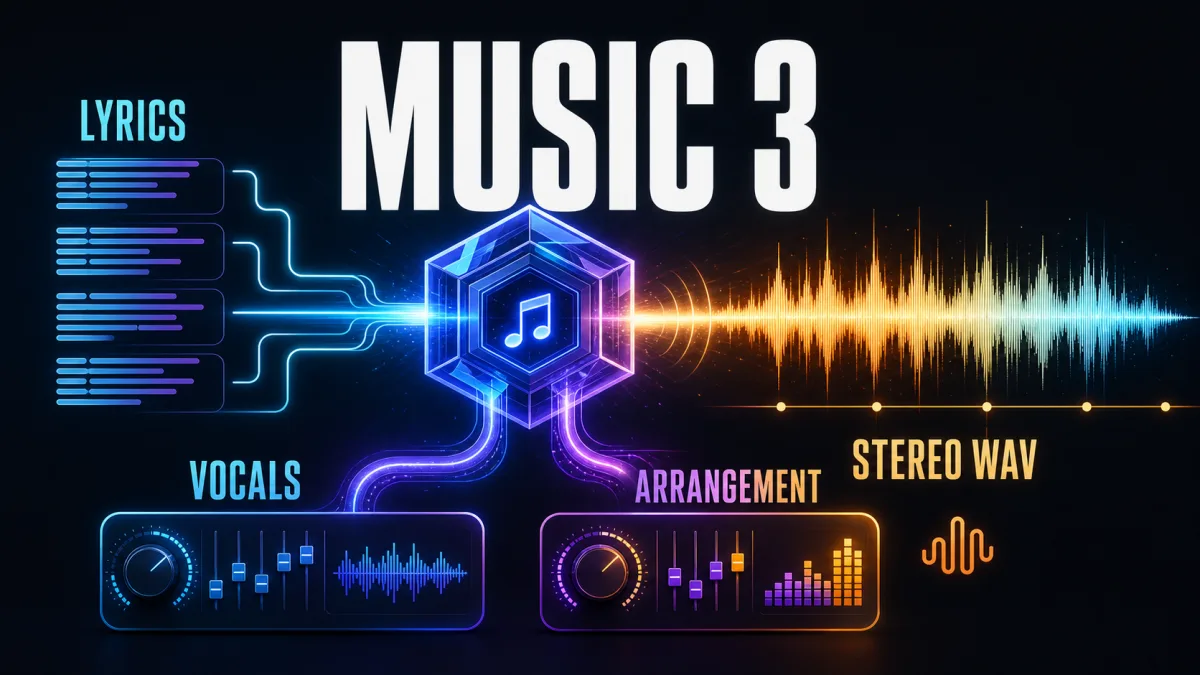
MiniMax Music 3 is a text-to-music model for complete songs up to five minutes, not an unlimited hosted music app. The published model card accepts lyrics plus a detailed music description, generates 32 kHz 16-bit stereo WAV audio, and documents local CUDA deployment through SGLang-Omni, diffusers and ComfyUI. The practical story is controllable long-form generation with a self-hosted setup, not a claim of free, limit-free access.
Definition: MiniMax Music 3 is a model for generating structured songs with lyrics, vocals, evolving arrangements and stereo audio.
Example: A prompt can combine section-tagged lyrics with a description of genre, BPM, vocal performance, instruments and production profile.
Key takeaway: The model exposes separate lyric and music controls, then uses a hybrid language-model and flow-synthesis stack to produce the track.
Business impact: Creators and product teams can evaluate a local music-generation pipeline, but they need CUDA hardware, a supported runtime and tests for how reliably the output follows the requested structure.
What does MiniMax Music 3 generate?
MiniMax Music 3 generates complete songs with expressive vocals, evolving arrangements and long-range musical coherence. The model card describes native generation of songs up to five minutes, including structures such as an intro, verse, pre-chorus, chorus, bridge, instrumental break and outro. That makes MiniMax Music 3 more relevant to full-song drafts than to short sound-effect clips; the first test should use a complete song structure rather than a single descriptive sentence.
MiniMax Music 3 outputs 32 kHz, 16-bit stereo WAV audio. The model card also says that song duration, tempo, key, instrumentation, lyrics and structure remain generative controls rather than strict symbolic guarantees. The useful expectation is therefore a coherent musical result shaped by instructions, not a deterministic sequencer that will reproduce every requested bar exactly.
How do lyrics and music prompts work?
MiniMax Music 3 separates the words to be sung from the description of how the song should sound. The lyrics input can contain section tags such as [Intro], [Verse], [Pre-Chorus], [Chorus], [Post-Chorus], [Bridge], [Instrumental], [Solo] and [Outro]; putting those tags on their own lines gives the model a structural map for the song.
The music description controls the musical layer: genre and subgenre, BPM, key, scale, emotional progression, vocal gender and timbre, performance style, harmonies, backing vocals, effects, instruments, groove, bass, percussion, textures and spatial effects. This split gives MiniMax Music 3 a practical prompt design: put lyrics and section order in one input, then use the description to specify the sonic direction.
MiniMax recommends a Structured Caption when a short natural-language prompt is not precise enough. The format has three parts:
- Global Metadata: genre, BPM, key, scale, emotion, listening scenario and production profile.
- Vocal Details: gender, timbre, delivery, harmonies, backing vocals and effects.
- Arrangement: primary and secondary instruments, their evolution by section, groove, bass, percussion, textures and spatial treatment.
The arrangement section is the important difference from a one-line style tag. A request can describe not only a sound at the start of a song, but also how instruments and energy should change as the track moves toward its chorus or outro.
What is inside the Music 3 architecture?
MiniMax Music 3 combines an 8B Global LLM, a 0.6B Local LLM and a continuous hidden-state synthesis path based on Flow Matching and Flow-VAE. The Global LLM models long-range semantics and musical structure; the Local LLM restores frame-level acoustic detail. The design separates the job of deciding what the song is doing from the job of recovering fine audio information.
The synthesis path uses fused hidden states, a 2.4B Flow Matching component and a 123M Flow-VAE decoder before producing 32 kHz stereo audio. MiniMax also describes an eight-layer residual-vector-quantization tokenizer for training, with one 16,384-entry semantic codebook and seven 1,024-entry acoustic codebooks. For operators, the main takeaway is that Music 3 is a multi-component audio system, so runtime memory and deployment complexity matter alongside the headline 8B model size.
How can you run MiniMax Music 3 locally?
MiniMax documents three local routes: SGLang-Omni, diffusers and ComfyUI. The model card requires CUDA and provides an SGLang-Omni service example, while the diffusers path is documented as a modular pipeline. The first deployment decision is therefore the runtime you already understand, not a promise that every desktop music app can load the checkpoint.
The official download command is:
hf download MiniMaxAI/MiniMax-Music3 --local-dir /path/to/minimax_ttm
For SGLang-Omni, the model card shows:
sgl-omni serve --model-path MiniMaxAI/MiniMax-Music3 --port 8000
The model card's generation example sends lyrics through input and the music description through instructions in a shared speech API. It also exposes a seed, an audio-token limit and a non-streaming request. Teams should begin with one short, repeatable prompt and save the resulting WAV file before attempting longer arrangements or automated batch generation.
Local sizing is not just a model-download question. MiniMax says full precision fits under 24 GB of VRAM; automatic CPU offloading brings generation to about 22 GB; and layer-by-layer streaming can fit on 8 GB cards with a speed penalty. Those figures are model-card guidance, not a guarantee for every GPU, driver or runtime. The guide to running an LLM locally explains the same separation between weights, runtime memory and workload, while the Local LLM Hardware Calculator can help reason about memory constraints even though Music 3 is an audio model rather than a language-only model. Related reading: MiniMax H3 brings 33B open-weight video generation.
What are MiniMax Music 3's limits?
MiniMax Music 3 requires CUDA, supports non-streaming generation only, limits tokenized text prompts to 5,000 tokens and limits audio generation to 9,000 acoustic frames. The model card's overview describes songs up to five minutes, while the frame ceiling is a separate technical limit whose exact relationship to duration is not explained in the documentation. Treat five minutes as the published song-length description, not as evidence of unlimited generation.
MiniMax Music 3 also does not guarantee strict symbolic control. A requested BPM, key, instrument, lyric or section may not be followed exactly, even when the prompt is well structured. Evaluation should therefore score both musical quality and instruction adherence: check whether the song contains the requested sections, whether the vocal direction survives the arrangement and whether the output length is useful for the intended product.
What changes for local music-generation teams?
MiniMax Music 3 makes the model/runtime boundary explicit. The model card gives developers a public checkpoint, several serving paths and a detailed control language for lyrics, vocals and arrangement. That is valuable for teams that need to keep generation inside their own environment or integrate audio creation into a larger pipeline, but the CUDA requirement and memory guidance make hardware a first-class part of the decision.
The release is best read as a local, controllable text-to-music system with a five-minute target—not as proof of free, unlimited or perfectly steerable generation. The next useful test is a fixed lyric and Structured Caption run across several seeds, followed by checks for structure, vocal consistency, arrangement changes, output duration and runtime cost. That evidence will say more about production readiness than a single impressive demo.
Frequently asked questions
What is MiniMax Music 3?
MiniMax Music 3 is MiniMax's text-to-music model for generating complete songs with vocals, evolving arrangements and long-range musical structure. The model card describes songs up to five minutes, 32 kHz 16-bit stereo WAV output, lyrics as one input and a music description as the other. The model is documented as a local inference project rather than an unlimited hosted consumer generator: it requires CUDA and can be served through SGLang-Omni, diffusers or ComfyUI.
How long can a MiniMax Music 3 song be?
MiniMax's model card describes complete songs up to five minutes and says the model supports up to 9,000 acoustic frames. The same documentation recommends treating the duration, tempo, instrumentation and song structure as generative controls rather than strict guarantees. A requested five-minute song can therefore have coherent long-range structure, but the generated tempo, key, lyrics and arrangement may not exactly match every instruction.
Can MiniMax Music 3 run locally?
Yes. MiniMax documents local deployment through SGLang-Omni, diffusers and ComfyUI, with CUDA required for inference. The model card says full precision fits under 24 GB of VRAM, automatic CPU offloading can bring generation to about 22 GB, and layer-by-layer streaming can fit on 8 GB cards at a slower speed. Actual performance still depends on the runtime and configuration.
Can I control the lyrics, vocals and instruments?
Yes, within generative limits. Lyrics can include section tags such as Verse, Chorus, Bridge and Outro. The music description can specify genre, BPM, key, emotional progression, vocal timbre and performance, harmony, backing vocals, effects, instruments, groove, percussion and spatial treatment. MiniMax recommends a Structured Caption with Global Metadata, Vocal Details and Arrangement for more precise control, but the model card warns that the output may not follow every requested detail exactly.
Alex
Founder & Lead AI Writer
Alex is the founder of Yowox and lead AI writer since 2024, breaking down complex information into clear, actionable insights for thousands of readers every day. Alex has built AI automation systems for businesses since 2024, focusing on AI agents, workflow automation, and business process optimization.
Save hours. Save thousands.
Practical guides, real workflows, and the latest AI and automation news that matters — straight to your inbox.