 By Alex
 Robots, AI and Agents are Vital for Supply Chains This Year.
Gartner’s 2026 supply-chain technology trends point toward a connected operating model where robots, physical AI, agentic software, simulation and governance work together.
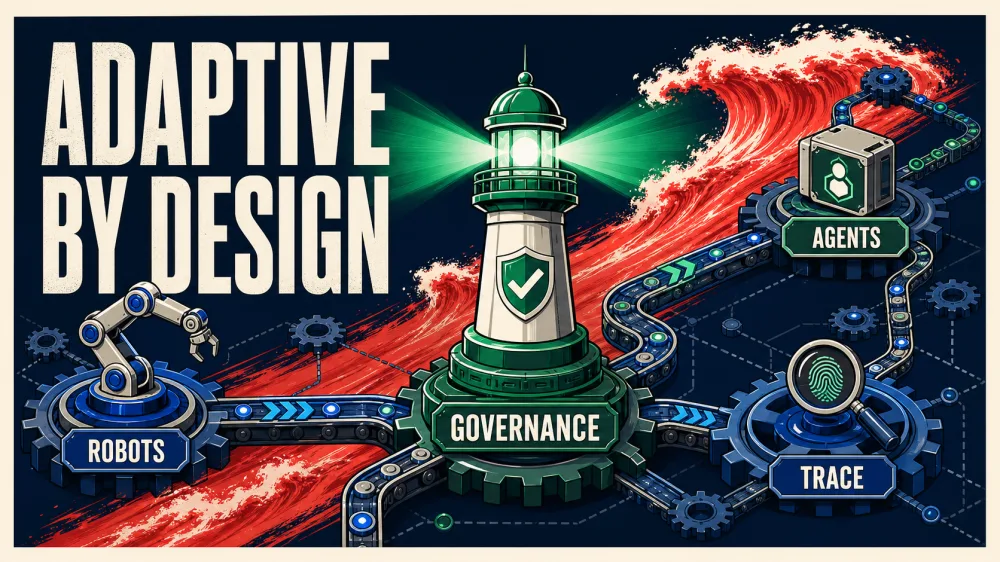
The supply-chain story for this year is not simply “add AI to the warehouse.” It is a shift toward systems that can sense conditions, make decisions, coordinate with one another, and act across digital and physical operations.
That is the message behind AI Magazine’s report on robots, AI and agents in Gartner’s 2026 supply-chain trends. Gartner’s own release names eight technologies, but the more important signal is how they fit together: autonomy needs intelligence, intelligence needs specialization, and both need governance before they can operate at scale.
Definition: The emerging AI supply chain combines software agents, physical systems, simulation, specialized models, traceability and decision controls into one operating environment.
Example: An agent detects a demand or capacity change, a simulation tests responses, a planner approves the policy, and a robot executes a bounded warehouse task.
Key takeaway: The competitive advantage will come from orchestration, not from buying the loudest individual AI tool.
Business impact: Connected systems can make operations more adaptive, but only when the organization can measure outcomes and keep high-impact decisions accountable.
Gartner’s three themes describe one connected system
Gartner organizes the eight trends into three themes: autonomy and agency, specialization and intelligence, and trust and governance (Gartner’s 2026 supply-chain technology release). They are easier to understand as layers of the same operating model than as a shopping list.
| Theme | What changes | Why it matters |
|---|---|---|
| Autonomy and agency | Systems plan, coordinate and act across workflows and environments | Routine decisions can move closer to real time |
| Specialization and intelligence | Models and simulations become more domain-aware | Decisions can reflect supply-chain constraints instead of generic patterns |
| Trust and governance | Organizations trace, monitor and control AI decisions | Automation becomes auditable and safer to scale |
A robot without good task orchestration is a costly island. An agent without reliable operational data is a confident guesser. A highly capable system without decision governance is an unmanaged source of risk.
Polyfunctional robots move beyond one fixed task
Traditional automation often excels at a defined motion in a controlled setting. Gartner’s polyfunctional-robot trend points to machines that can take on multiple tasks and adapt to changing work, particularly where labor shortages make flexibility valuable.
The important distinction is not “robot versus human.” It is fixed-purpose automation versus a more adaptable workforce layer. A machine that can move goods, scan inventory, inspect a location, or perform several related tasks may be more useful than several narrow systems that each need their own installation, maintenance and integration path.
That does not mean every warehouse should replace specialized equipment. Specialized systems can be faster, cheaper and easier to validate for high-volume work. The practical question is where flexibility has measurable value: exception handling, variable SKU environments, seasonal demand, or work areas where reconfiguration is expensive.
Physical AI connects perception to action
Physical AI brings models into the operating environment through sensors, robotics and automation systems. It is the layer that lets a system detect what is happening in a factory, warehouse or transport network and respond to conditions rather than follow a static script.
This creates a different engineering requirement from ordinary analytics. A dashboard can be wrong and still be corrected in the next planning meeting. A physical system acts against inventory, equipment, people and time-sensitive operations. Sensor quality, latency, fallback behavior and safety boundaries become part of the AI product.
In practice, the stack needs to answer three questions:
- What does the system actually observe?
- Which decisions may it make without approval?
- What happens when its data is missing, contradictory or late?
Physical AI is valuable only when those answers are designed before the model is connected to machinery.
Agentic AI changes the unit of automation
Traditional automation follows explicit inputs and predefined outcomes. Agentic AI is being positioned as a virtual workforce that can plan, act and adapt toward a goal in a more complex environment.
That makes an agent a promising fit for exception triage, procurement coordination, inventory investigation, shipment rerouting or supplier communication. It can interpret an evolving situation and choose among tools instead of waiting for one narrowly formatted trigger.
It also changes the risk profile. When a system can act, the important design question is not how fluent its explanation sounds. It is which systems it can call, what limits those tools enforce, and who owns the outcome. An AI agent uses tools and feedback to pursue a goal; a supply-chain agent therefore needs explicit operational tools, not vague permission to “manage inventory.”
Gartner’s earlier forecast predicted that 50% of cross-functional supply-chain management solutions would use intelligent agents to autonomously execute decisions by 2030 (Gartner’s agentic-AI forecast). A forecast is not a deployment plan. It is a reason to build the control model before autonomy becomes embedded in critical workflows.
Collaborative agents coordinate specialized work
A single general-purpose agent is not automatically the best architecture. Supply chains already contain specialized functions: demand planning, sourcing, fulfillment, transportation, quality, compliance and customer service.
Collaborative multiagent systems reflect that structure by assigning different tasks or domains to different agents. One agent might identify a replenishment risk, another might check supplier constraints, and another might prepare a logistics option. Coordination can make multistep work more scalable, but it also introduces new failure modes:
- agents may disagree about the current state;
- one agent may act on stale output from another;
- responsibility may become unclear when a plan crosses departments;
- a local optimization may create a network-level problem;
- failures can propagate faster than a human review cycle.
The remedy is to define shared state, ownership, handoff conditions, escalation rules and logs. Multiagent coordination should look more like a governed workflow than a group chat between autonomous personalities.
Intelligent simulation tests decisions before operations do
Intelligent simulation applies AI, machine learning and advanced analytics to models of logistics, transportation, warehouses and other operating environments. Its value is making “what if?” useful while a decision is still reversible.
Before rerouting a network, changing a warehouse layout or altering replenishment logic, a planning team can compare scenarios against constraints and likely outcomes. Simulation can help explore demand shifts, capacity bottlenecks, delays and resource tradeoffs.
Simulation should remain a decision aid, not a permission slip. A model can miss a supplier dependency, an unusual event or a data-quality problem. The strongest workflow uses simulation to narrow the options, then applies business rules, human judgment and explicit approval where consequences are material.
Specialized models and product provenance improve context
General-purpose models know a great deal about language. They do not automatically understand a company’s product hierarchy, supplier terms, lead times, compliance rules, warehouse conventions or planning calendar.
Domain-specific language models are intended for targeted supply-chain use cases, where specialization can improve accuracy, reliability and compliance. But model specialization is only one part of context. The surrounding data foundation still needs clear definitions, ownership, freshness indicators and access controls.
Product provenance adds another trust layer: where a product originated, which transformations it passed through, and how its journey can be verified. AI can help connect records, identify anomalies and surface missing links, but it cannot manufacture trustworthy provenance from incomplete source systems.
Provenance supports recalls, supplier investigations, quality checks and customer claims. It also gives AI systems a better evidence base when they recommend or execute a decision involving a product’s status.
Decision governance makes autonomy deployable
The final trend is the one that determines whether the others survive contact with production. Decision governance creates frameworks and guardrails for AI-enabled choices so they remain transparent, accountable and compliant.
Governance should be operational, not a document that sits beside the system. It needs to define:
- which decisions an agent may make automatically;
- which actions require approval;
- which data sources are authoritative;
- what evidence or simulation result is required;
- how exceptions are escalated;
- how actions and outcomes are recorded;
- how policy changes when a model, supplier or regulation changes.
A good governance layer is not an argument against speed. It makes safe speed possible by allowing routine, reversible work to move quickly while reserving review for actions that can disrupt service, spend money, affect safety or change contractual commitments.
What supply-chain leaders should do this year
The practical response to Gartner’s trends is not to launch eight pilots. It is to choose one operational bottleneck and build the full loop around it.
Start with a bounded workflow
Choose a use case with measurable inputs and outcomes: a replenishment exception, a delivery-delay investigation, a supplier-document check or a warehouse inspection queue. Define what the system can read, recommend and execute.
Make behavior verifiable
Use high-quality data, explicit business rules and a test set of real historical cases. If the team cannot tell whether an agent’s recommendation was correct, it is too early to grant autonomous authority.
Keep physical actions reversible where possible
A simulation, recommendation or draft purchase order is easier to govern than an automatic cancellation or a machine instruction that changes a live operation. Introduce autonomy in stages and record the boundary at each stage.
Design the human role instead of adding a human button
People should know what they are approving, what evidence supports it, and what happens next. A vague approval prompt creates ceremony, not accountability. Review queues need useful context, deadlines and clear ownership.
Measure the operating outcome
Track service levels, inventory health, throughput, exception resolution time, safety events, data-quality failures and cost. “The model responded” is not a supply-chain metric. Neither is the number of agents deployed.
The real shift is orchestration
Robots, physical AI, agentic software, simulation, specialized models and provenance systems are often discussed as separate technology trends. Gartner’s grouping suggests a more useful interpretation: they are pieces of an operating model that must work together.
The supply chains that benefit most will not necessarily be the ones with the most autonomous components. They will be the ones that connect sensing, reasoning, simulation, execution and governance into a system people can understand and improve.
This year’s question is therefore not “Where can we put a robot or an agent?” It is: Which decision should become more adaptive, what evidence should support it, and which boundary must remain accountable to a person?
Frequently asked questions
What are Gartner’s top supply-chain technology trends for 2026?
Gartner groups eight trends under autonomy and agency, specialization and intelligence, and trust and governance. They include polyfunctional robots, physical AI, agentic AI, collaborative multiagent systems, intelligent simulation, domain-specific language models, product provenance, and decision governance.
Why are robots and AI being discussed together in supply chains?
Software agents can plan and coordinate work, while physical AI combines models with sensors, robotics, and automation so systems can sense and act in real environments. The operational opportunity comes from connecting those layers rather than deploying a chatbot or robot as an isolated project.
Are AI agents ready to run supply chains autonomously?
Gartner describes a direction toward more autonomous decision execution, not a guarantee that every workflow is ready for unsupervised operation. Teams should begin with narrow use cases where data quality is high, behavior is verifiable, operational parameters are clear, and people can intervene when the cost of an error is high.
What governance do supply-chain AI systems need?
They need explicit decision boundaries, accountable owners, traceable data and product provenance, monitoring, approval paths for high-impact actions, and records that explain what the system decided and why. Governance must cover the full chain from model output to software execution and physical action.
Alex
Founder & Lead AI Writer
Alex is the founder of Yowox and lead AI writer since 2024, breaking down complex information into clear, actionable insights for thousands of readers every day. Alex has built AI automation systems for businesses since 2024, focusing on AI agents, workflow automation, and business process optimization.
Save hours. Save thousands.
Practical guides, real workflows, and the latest AI and automation news that matters — straight to your inbox.